

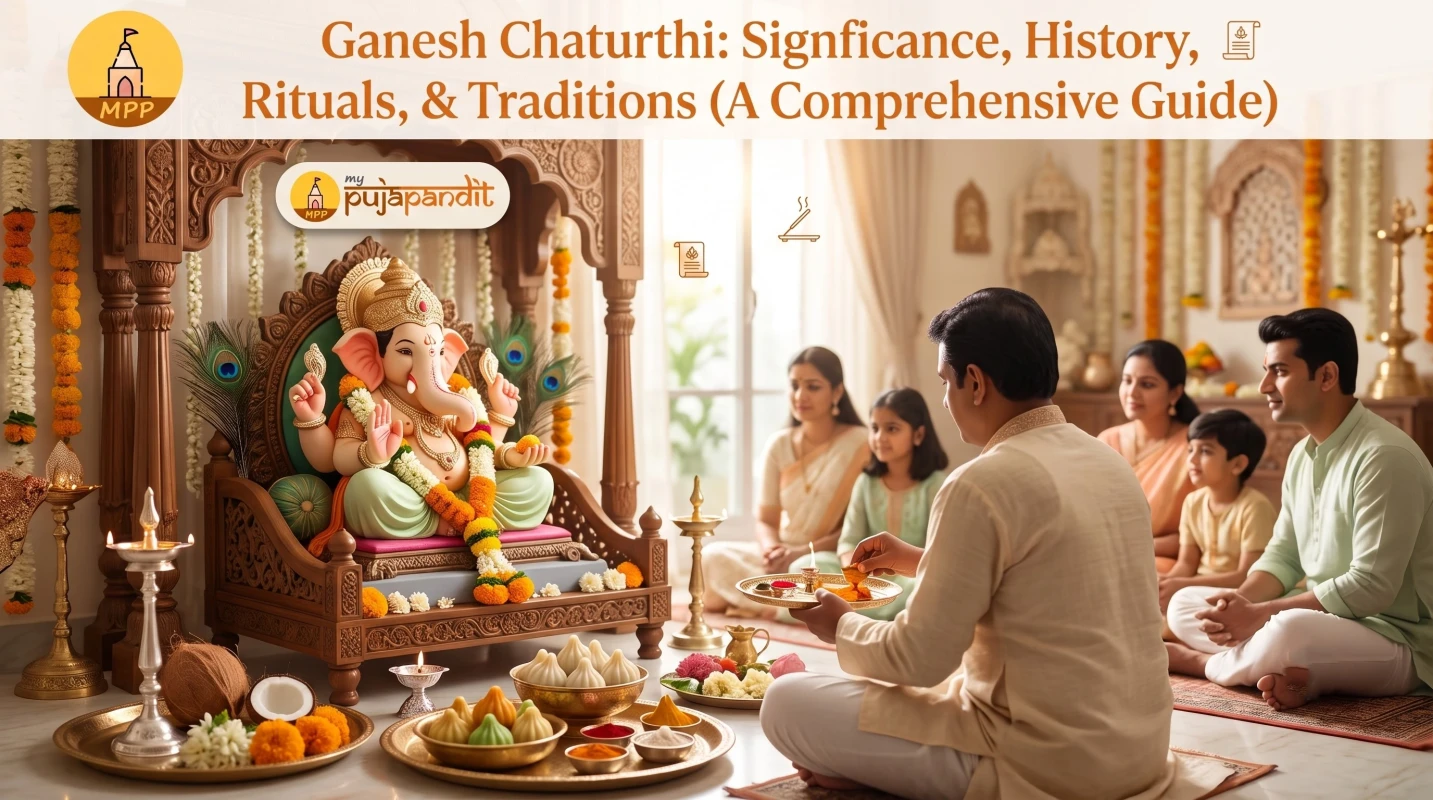
Ganesh Chaturthi Significance, History, Rituals, Traditions & Why We Celebrate
Ganesh Chaturthi is one of the most popular Hindu festivals observed in honour of Lord Ganesha, the revered deity linked with wisdom, knowledge, prosperity, favourable beginnings, and the removal of obstacles. This festival is celebrated on the fourth day of the bright half of the Hindu month of Bhadrapada, known as Shukla Paksha Chaturthi. It combines religious observance, family customs, communal festivities, artistic expressions, and cultural practices.
To truly understand the significance of Ganesh Chaturthi, one must appreciate its deep roots in Hindu mythology, the sacred bond between Lord Shiva and Goddess Parvati, its spiritual essence, traditional ceremonies, and the diverse customs followed in various parts of the country.
The celebration of Ganesh Chaturthi varies greatly from one region to another, with large public events in Maharashtra and more intimate family rituals in states like Bihar, Karnataka, Goa, Telangana, Andhra Pradesh, Tamil Nadu, and Gujarat.
This guide delves into the origins, meaning, religious beliefs, spiritual values, rituals, traditions, and regional significance of Ganesh Chaturthi, offering a comprehensive overview of this sacred occasion.
The Mythological Birth of Lord Ganesha
There are several ways in which the birth of Lord Ganesha has been narrated in Hindu scriptures and Puranas, with each narrative providing slight differences in the details of the story. The most popular narration is that Lord Ganesha is the son of Goddess Parvati.
As per the popular mythological story, Lord Ganesha was created by Goddess Parvati out of the sacred flesh of her body and was told to watch at the gate while she went for her bath. As Lord Shiva came and tried to get inside, Lord Ganesha denied him entry on account of following his mother's orders.
The incident led to a fight, and during the same, Lord Shiva cut off Ganesha's head. After learning of this incident, Goddess Parvati became enraged and asked that her son be resurrected.
This was done by Lord Shiva by putting an elephant's head on Ganesha. This made Ganesha a divine being.
The Role of Lord Shiva in Ganesha's Story
Lord Shiva’s Role in the Traditional Story of the Birth of Lord Ganesha
The relationship between Lord Shiva and Ganesha is a narrative that is built around duties, identity, and divinity. With the knowledge that Ganesha is Parvati’s son, Lord Shiva brings back Ganesha and makes him an important god within the Hindu pantheon. Following this, Ganesha becomes a god of overcoming obstacles and of being worshipped first before any important activity is attempted; he earns his titles of Vighnaharta and Pratham Pujya. This is the basis for the traditional worship of Ganesh before marriage ceremonies, house-warming events, business ventures, and more.
What Is Ganesh Chaturthi?
Ganesh Chaturthi is a Hindu religious event celebrated in honour of Lord Ganesha, marking the divine birthday of Lord Ganesha. This festival is celebrated on the fourth day, which is referred to as Chaturthi Tithi, of the Shukla Paksha month of Bhadrapada. It is worth noting that this particular day falls on different dates each year, depending on the Gregorian calendar. At Ganesh Chaturthi, devotees can place an idol made of clay or any other traditional materials of Lord Ganesha at their homes, temples, or pandals. They offer prayers to him for a period of time dictated by custom, followed by the Visarjan of Ganesh.
Why Is Ganesh Chaturthi Celebrated?
The celebration of Ganesh Chaturthi takes place in order to worship Lord Ganesha as well as to seek blessings from him in the form of wisdom, prosperity, auspiciousness, and elimination of obstacles. The significance of the Ganesh Chaturthi Festival may be perceived through different aspects as follows:
- The celebration of the divine birth of Lord Ganesha
- seeking wisdom and knowledge
- praying for success in important endeavours
- worshipping Ganesha as an obstacle remover
- promoting family and communal involvement
- preserving Hindu religion
- facilitating spiritual meditation
- bringing together people in cultural festivals.
Thus, the significance of the Ganesh Chaturthi festival is not restricted merely to being religious, but it has grown into a significant cultural tradition in many parts of India as well as in other countries where Hindus live.
Significance of Ganesh Chaturthi
The significance of Ganesh Chaturthi can be understood through three major dimensions: religious, spiritual, and cultural significance.
Religious Significance of Ganesh Chaturthi
The religious importance of Ganesh Chaturthi is connected to Lord Ganesha.
Lord Ganesha is the deity of wisdom, intellect, auspicious beginnings, and the destroyer of obstacles. His worship is necessary for all people in order to receive blessings from him for a prosperous and harmonious life and for the successful performance of any work. Observant Hindus traditionally observe Ganesh Chaturthi by conducting a ceremony in the home or temple. They may perform a traditional puja to the deity, present flowers and durva grass, Prepare a vegetarian meal known as naivedya, recite prayers and mantras, and engage in aarti. The procedure for the rite and the components that go into it may vary depending on local customs, family rituals, and the specific puja being performed.
Spiritual Significance of Ganesh Chaturthi
The inner spiritual meaning of Ganesh Chaturthi is much deeper than the merriment that it creates on the surface. There are many lessons embedded in the image of Lord Ganesha. Lord Ganesha has a bigger head, indicating his superior intelligence and wider mind; big ears, indicating that one should always listen more carefully; and a mouse, which is a symbol of desire and temptation that is controlled by him.
The festival therefore encourages devotees to develop qualities such as:
- Wisdom
- Patience
- Self-control
- Humility
- Discernment
- Positive thinking
- Devotion
Ganesh Chaturthi can consequently serve as an opportunity for spiritual reflection and personal growth.
Cultural Significance of Ganesh Chaturthi
The cultural significance of Ganesh Chaturthi is reflected in the large public celebrations that take place in India. These grand public festivals, with their large community pandals, artistic idols, music, devotional performances, cultural programmes, processions, and public gatherings, have contributed to making this festival an important part of Indian regional traditions. It was in Maharashtra that public Ganesh Chaturthi festivals acquired particular prominence in the last decades of the 19th century, and it was largely due to Bal Gangadhar Tilak’s efforts that the festival took on its modern form as a public holiday. Nowadays, the Ganesh Chaturthi festival is celebrated throughout India and in different ways, as every region has its unique customs and traditions.
Ganesh Chaturthi Traditions and Beliefs
Ganesh Chaturthi traditions and beliefs have developed through generations of religious practice and regional customs.
Common traditions include:
- Installing a Ganesha idol
- Performing Ganesh Puja
- Offering flowers and durva grass
- Preparing traditional offerings such as modak
- Performing aarti
- Chanting devotional prayers and mantras
- Decorating homes and community pandals
- Organising cultural programmes
- Conducting processions
- Performing Ganesh Visarjan
Not every family follows the same procedure. Ritual details may differ depending on local customs, sampradaya, family tradition, and the type of puja being performed.
Ganesh Chaturthi Traditions
The most common Ganesh Chaturthi traditions begin with preparing a clean and sacred space for the deity.
Devotees may establish the idol, perform a sankalpa, offer traditional puja materials, conduct aarti, and distribute prasad.
Modak is particularly associated with Lord Ganesha and is commonly offered as naivedya during the festival.
Many families also observe daily worship during the period for which the idol is kept.
For devotees who want assistance with traditional rituals, an online priest-booking service can make the process more convenient. Those looking to book my pandit for Ganesh Chaturthi can select a suitable priest and puja service based on their requirements.
Ganesh Chaturthi Decorations
Ganesh Chaturthi decorations are an important part of the festival.
Homes and public pandals are often decorated with:
- Flowers
- Rangoli
- Diyas
- Decorative fabrics
- Traditional motifs
- Leaves and natural materials
- Handmade decorations
- Thematic backdrops
In recent years, environmentally responsible decoration has gained importance. Many devotees prefer reusable, biodegradable, or natural decorative materials rather than excessive plastic.
The focus can be on creating a beautiful devotional environment while also respecting nature.
Ganesh Chaturthi Procession
The Ganesh Chaturthi procession takes on a special significance during Ganesh Visarjan. At the end of the festival, the Ganesha idols are taken out in a procession in which people sing, play music, dance, and chant while taking the idols to immerse them in water. The idol is immersed in water according to local traditions. Ganesh Visarjan has a philosophical message behind it – the idol made of clay returns to the earth, signifying the life cycle of creation and destruction. The immersion of Lord Ganesh idols is becoming more and more environmentally friendly. Many communities are taking steps to ensure that eco-friendly idols are used during immersion.
Ganesh Chaturthi Rituals
Ganesh Chaturthi rituals vary across regions and families but commonly include:
- Cleaning and preparing the puja space
- Installing the Ganesha idol
- Kalash Sthapana, where prescribed by the chosen puja tradition
- Sankalpa
- Invocation and worship of Lord Ganesha
- Offering flowers and durva
- Offering naivedya
- Reciting prayers or mantras
- Performing aarti
- Distributing prasad
- Ganesh Visarjan
For a detailed ritual, it is advisable to follow the procedure prescribed by a knowledgeable priest according to the family's tradition.
Kalash for Ganesh Chaturthi
kalash for Ganesh Chaturthi can be a part of the traditional puja arrangement. In the Hindu ritual practice, the kalash is believed to symbolize auspiciousness, purity, abundance of riches and the presence of divine blessings. While the method of Kalash Sthapana, the materials, and mantras can vary depending on the tradition of the puja.
Therefore, if you are performing an elaborate Ganesh Chaturthi puja, following the guidance of a qualified priest can help to ensure that it is done according to the intended tradition
What Does Ganesh Chaturthi Teach Us?
The importance of Ganesh Chaturthi is not limited to rituals. The festival also carries several symbolic life lessons.
1. The Importance of Wisdom
Lord Ganesha is traditionally associated with intellect and wisdom. His worship reminds devotees that knowledge and good judgement are essential for overcoming challenges.
2. The Importance of Listening
Ganesha's large ears are traditionally interpreted as a reminder to listen carefully and understand before responding.
3. Respect for Parents
The stories associated with Ganesha and his parents emphasise devotion, duty, and respect within the family.
4. Overcoming Obstacles
As Vighnaharta, Lord Ganesha represents the hope that difficulties can be overcome through wisdom, discipline, faith, and appropriate action.
5. Accepting Change
Ganesh Visarjan reminds devotees that material forms are temporary and that change is an inherent part of life.
How to Perform Ganesh Chaturthi Puja at Home?
A basic home Ganesh Chaturthi Puja generally begins by cleaning the worship area and preparing a suitable place for the Ganesha idol.
The puja may include:
- Ganesha idol
- Kalash
- Clean water
- Flowers
- Durva grass
- Akshata
- Sandalwood
- Incense
- Diya
- Fruits
- Naivedya
- Modak
- Other materials prescribed by the chosen ritual tradition
After the preparation, devotees can perform the puja according to their family tradition.
For more elaborate ceremonies, the sequence of mantras, sankalpa, offerings, and other ritual steps can vary. Therefore, professional guidance can be useful.
If you are not familiar with the procedure, you can book my pandit for assistance with a traditional Ganesh Chaturthi Puja according to the service and ritual requirements selected.
Why Choose a Qualified Pandit for Ganesh Chaturthi Puja?
Religious ceremonies involve specific procedures, mantras, offerings, and traditional practices. A knowledgeable priest can help devotees conduct an elaborate puja in an organised manner.
A qualified pandit can be particularly helpful when:
- You are performing Ganesh Puja for the first time
- You want a traditional Vedic-style ceremony
- You are conducting a special sankalpa
- You need guidance regarding puja samagri
- You want assistance with the ritual sequence
- Your family follows a specific regional tradition
When choosing an online priest-booking service, users should consider the priest's qualifications, experience, language capability, ceremony details, inclusions, and transparent service information.
Platforms such as My Puja Pandit can help make priest booking more accessible for devotees who prefer arranging religious services online.
This approach also supports a stronger experience based on Experience, Expertise, Authoritativeness, and Trustworthiness (EEAT) by encouraging users to verify the qualifications and services of the priest before booking.
The Deeper Ganesh Chaturthi Importance
When viewed holistically, Ganesh Chaturthi's importance extends across religion, spirituality, culture, family life, and community participation.
Religious Importance
It is a major festival dedicated to Lord Ganesha and his divine birth.
Spiritual Importance
It encourages wisdom, self-control, patience, devotion, and reflection.
Cultural Importance
It preserves regional traditions, music, art, food, craftsmanship, and community celebrations.
Social Importance
Public celebrations bring communities together and create opportunities for collective participation.
Environmental Awareness
Modern celebrations increasingly emphasise eco-friendly idols, responsible decoration, and environmentally conscious immersion practices.
Thus, Ganesh Chaturthi continues to evolve while retaining its core religious identity.
Conclusion
Lord Ganesha is a symbol of wisdom, auspiciousness, intellect, and the remover of all obstacles. Lord Ganesha’s birth story is rooted in Goddess Parvati and Lord Shiva’s mythological relationship, but his unique nature teaches people about the values of knowledge, listening, humility, and a lot more.
Book your pandit in Maharashtra, Karnataka, Goa, Telangana, Andhra Pradesh, Tamil Nadu, Gujarat, Bihar, or any other region through the book my pandit and my puja pandit portals if you want to hire an experienced priest for your Ganesh Chaturthi and have a spiritually healing experience. Ganesh Chaturthi’s ultimate lesson is that good harvests, achievements, and successes are not just the results of removing all obstacles on your path. Instead, it is the fruit of wisdom, patience, humility, and other virtues that Lord Ganesha embodies.
Frequently Asked Questions About Ganesh Chaturthi
Does Ganesh Chaturdashi mean Lord Ganesha as the remover of obstacles?
No. Ganesh Chaturthi and Chaturdashi refer to different lunar tithis. Ganesh Chaturthi is the fourth lunar day and is associated with the celebration of Lord Ganesha's birth.
Lord Ganesha, however, is traditionally known as Vighnaharta, or the remover of obstacles. This is why devotees commonly worship him before beginning auspicious activities.
Why is Ganesh Chaturthi important?
Ganesh Chaturthi is important because it celebrates Lord Ganesha and allows devotees to seek blessings associated with wisdom, auspiciousness, prosperity, and overcoming obstacles. It also has significant spiritual, cultural, and social importance.
What is the religious significance of Ganesh Chaturthi?
Its religious significance comes from the worship of Lord Ganesha, who is traditionally regarded as the deity of wisdom, auspicious beginnings, and the removal of obstacles.
What is the spiritual significance of Ganesh Chaturthi?
The spiritual significance includes developing wisdom, self-control, patience, humility, and the ability to overcome difficulties with discernment.
What is the cultural significance of Ganesh Chaturthi?
Ganesh Chaturthi is an important cultural festival involving traditional worship, music, art, food, decorations, community gatherings, and processions. Its cultural expression differs across Indian regions.
What is used for Ganesh Chaturthi Puja?
Common puja materials include a Ganesha idol, kalash, water, flowers, durva grass, akshata, sandalwood, incense, diya, fruits, naivedya, and modak. Exact requirements depend on the ritual tradition.
Can I book a pandit for Ganesh Chaturthi Puja?
Yes. Devotees can use online priest-booking services to arrange Ganesh Chaturthi Puja at home. Before booking, check the pandit's experience, qualifications, puja procedure, inclusions, and service details.
Why is Ganesh Chaturthi celebrated for several days?
Different families and communities follow different traditions for the duration of the celebration. The Ganesha idol may be worshipped for a chosen period before being taken for Visarjan.
What is the significance of Ganesh Visarjan?
Ganesh Visarjan represents the return of the temporary idol to nature. It is often understood symbolically as a reminder of impermanence, transformation, and the cyclical nature of existence.
Is Ganesh Chaturthi celebrated only in Maharashtra?
No. Maharashtra is particularly famous for its large-scale celebrations, but Ganesh Chaturthi is observed in many Indian states, including Karnataka, Goa, Telangana, Andhra Pradesh, Tamil Nadu, Gujarat, Bihar, and others.